

When anxiety rises, breathing is often the first thing to change — it gets fast, shallow, and tight in the chest. That’s not a flaw in your body; it’s part of the stress response. The useful part? Breathing is also one of the few parts of that response you can change on purpose. Breathwork for anxiety means using slow, deliberate breathing to calm the body, and it’s a skill you can pick up in minutes and use anywhere: before a meeting, on a train, or at 3 am when your mind won’t quieten.
Here are five simple techniques, each with step-by-step instructions, when to use it, and what the evidence supports. None of them needs equipment, an app, or a special place. All five can be done in five minutes or less.
How Breathwork Helps — and What It Does Not Do
Slow breathing works mainly by calming the body’s stress system. When you breathe slowly — especially with a longer exhale than inhale — your heart rate tends to slow, muscle tension eases, and that feeling of panic often softens. Research supports slow breathing as a helpful tool for easing anxiety symptoms in the moment and, with regular practice, for reducing day-to-day stress.
That’s real, but it has limits. Breathwork helps symptoms; it doesn’t replace treatment for anxiety disorders. If you have frequent panic attacks, anxiety that stops you working or sleeping, or low mood that doesn’t lift, breathing alone isn’t enough — and that’s not a failure on your part. Talk to a doctor or a mental-health professional. Breathwork can sit alongside treatment, not instead of it.
A safety note before you start: breathing exercises are safe for most people, but stop and breathe normally if you feel dizzy, light-headed, or uncomfortable. Don’t practise forceful breathing while driving, and if you have asthma, a lung condition, low blood pressure, or you are pregnant, check with your doctor before trying a new breathing technique — especially one that involves holding your breath.
Before You Begin: The Basics
All five techniques share the same basics:
- Sit or lie comfortably, with your back supported. You can also stand, if that is easier.
- Relax your shoulders and unclench your jaw.
- Breathe through your nose where you can, unless a technique says otherwise.
- Do not force it. Breathing should feel comfortable, not strained. If a count feels too long, shorten it.
- Start with two to five minutes. A short, regular practice helps more than a long, occasional one.
1. Box Breathing — for Calm Focus Before a Stressful Moment
Box breathing, also called square breathing, is used by athletes, soldiers, and public speakers before stressful moments. It’s simple, structured, and easy to remember when your mind is racing.
How to do it:
- Breathe in slowly through your nose for a count of 4.
- Hold your breath for a count of 4.
- Breathe out slowly through your mouth for a count of 4.
- Hold your breath for a count of 4.
- Repeat for 4 to 6 rounds, about 2 to 3 minutes.
When to use it: Before a meeting, an exam, a difficult conversation, or any moment when you need to feel steady and focused. It’s a good first technique to learn, because the equal counts give your mind something to hold on to.
Tip: If a count of 4 feels too long, use 3. The even rhythm matters more than the exact number.
2. 4-7-8 Breathing — for Falling Asleep or Calming a Racing Mind
The 4-7-8 technique, popularised by Dr Andrew Weil, uses a long exhale to slow the body down. It’s especially useful at night, when your mind is busy and sleep feels far away.
How to do it:
- Sit or lie down comfortably. Place the tip of your tongue behind your upper front teeth and keep it there.
- Breathe out completely through your mouth, with a gentle whooshing sound.
- Close your mouth and breathe in quietly through your nose for a count of 4.
- Hold your breath for a count of 7.
- Breathe out slowly through your mouth for a count of 8.
- Repeat for 4 cycles to start. Do not do more than 8 cycles in one session when you are new to it.
When to use it: At bedtime, or when anxiety is keeping you awake. It’s also useful during a stressful evening, when you want to wind down.
Tip: The long hold and exhale can feel strange at first. If 7 and 8 feel too long, start with 3-5-6 and build up over a few days. Never force the hold — if you feel uncomfortable, breathe normally.
3. Slow Exhale Breathing — the Simplest Technique, for Any Anxious Moment
If you remember only one technique from this article, make it this one. Slow exhale breathing is the easiest to use in the middle of a busy day, because it needs no counting pattern and no special posture.
How to do it:
- Breathe in through your nose for a count of 2.
- Breathe out slowly through your mouth for a count of 4 — twice as long as the inhale.
- Repeat for 2 to 5 minutes, keeping the exhale slow and steady.
When to use it: Anytime anxiety rises — in traffic, in a queue, during a work call, or when you feel your chest tighten. You can do it without anyone noticing, which makes it the most practical technique on this list.
Why it works: A longer exhale than inhale signals the body to slow down. It’s the core of most breathing techniques, and it’s enough on its own. If you feel panicky, focus only on making the exhale slow and complete.
4. Humming Breath (Bhramari) — for a Busy Mind and Tension
Humming breath, known in yoga as bhramari, combines a slow exhale with a gentle humming sound. The vibration and the sound give your mind something to focus on, which helps when thoughts are racing.
How to do it:
- Sit comfortably with your eyes closed.
- Breathe in slowly through your nose.
- As you breathe out, make a soft humming sound, like a bee, with your lips closed. Feel the gentle vibration in your face and throat.
- Continue for 5 to 10 breaths, about 2 to 3 minutes.
- Sit quietly for a moment afterwards and notice how you feel.
When to use it: When your mind won’t stop, when you feel irritated or tense, or as part of an evening wind-down. It’s a traditional Indian practice, and many people find it more soothing than silent breathing.
Tip: Keep the hum soft and comfortable. If you have a cold, a sore throat, or an ear problem, skip this one and use slow exhale breathing instead.
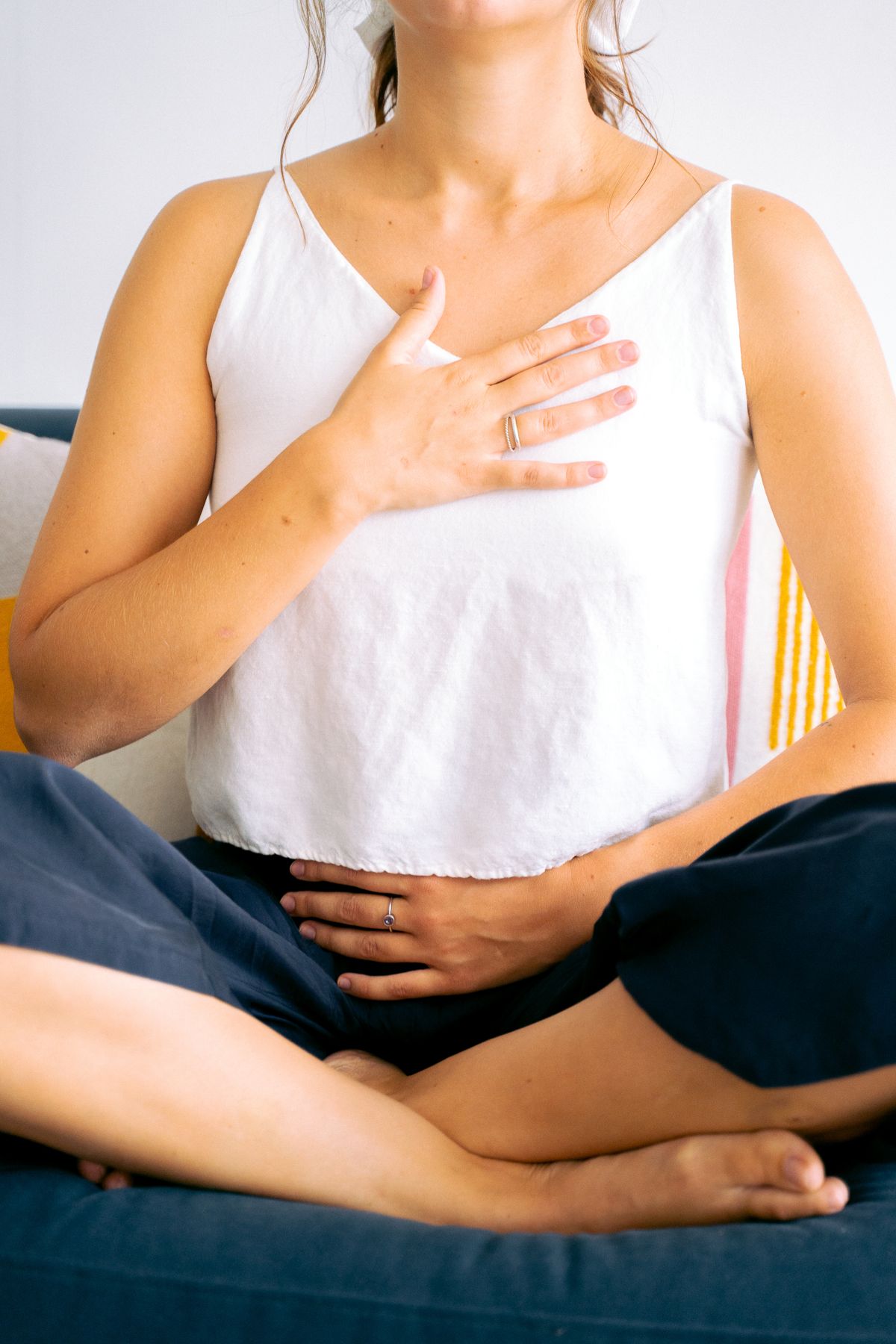
5. Belly Breathing (Diaphragmatic Breathing) — for Daily Practice
When we’re anxious, we tend to breathe high in the chest, with short, shallow breaths. Belly breathing retrains the body to breathe lower and fuller, using the diaphragm — the muscle under your lungs.
How to do it:
- Lie down or sit comfortably. Place one hand on your chest and one on your belly.
- Breathe in slowly through your nose, letting your belly rise under your hand. Your chest should move only a little.
- Breathe out slowly through your mouth, feeling your belly fall.
- Continue for 5 minutes, aiming for about 6 breaths a minute — roughly 5 seconds in, 5 seconds out.
When to use it: As a daily practice, morning or evening, for 5 minutes. It’s also useful when you notice you’re breathing in your chest and feeling tense. With regular practice, belly breathing becomes more natural, and you may find you breathe more slowly even when you’re not trying.
Tip: If belly breathing feels unnatural at first, that’s normal. Practise lying down, where it’s easier, before trying it sitting up.
Breathwork for Anxiety: Which Technique Should You Choose?
| Technique | Best for | Time needed |
|---|---|---|
| Box breathing | Focus before a stressful moment | 2–3 minutes |
| 4-7-8 breathing | Sleep, racing mind at night | 2–4 minutes |
| Slow exhale | Any anxious moment, anywhere | 2–5 minutes |
| Humming breath | Busy mind, tension, evening wind-down | 2–3 minutes |
| Belly breathing | Daily practice, retraining your breathing | 5 minutes |
You don’t need to master all five. Learn one — slow exhale is the easiest — and use it for a week. Then add a second, such as box breathing or 4-7-8, for a different situation. Regular practice matters more than variety.

Building a 5-Minute Daily Habit
A small daily habit is more useful than a long session once in a while. Try this:
- Morning: 5 minutes of belly breathing after waking, before checking your phone.
- During the day: Slow exhale breathing for a minute or two when stress rises.
- Evening: 4-7-8 breathing or humming breath as part of your wind-down.
Link breathing to something you already do — after brushing your teeth, while waiting for chai to brew, or on your commute — so you remember it. If you miss a day, don’t worry; just start again the next day.
What the Evidence Supports — and What It Does Not
Slow breathing has good support for reducing anxiety symptoms in the moment and for lowering stress with regular practice. It’s low-cost, low-risk, and available to almost everyone. That makes it a useful tool, not a miracle cure.
What breathwork doesn’t do is treat the causes of an anxiety disorder on its own. Anxiety can come from many sources — life stress, past experiences, medical conditions, or brain chemistry — and some of those need professional help, therapy, or medicine. If breathing helps a little but anxiety keeps interfering with your life, that’s a sign to seek support, not a sign that you’re doing breathing wrong.
When to Seek Help
Talk to a doctor or a mental-health professional if:
- Anxiety is frequent, intense, or hard to control
- You have panic attacks, or you avoid places and situations because of anxiety
- Anxiety stops you sleeping, working, or enjoying life
- You feel low, hopeless, or have thoughts of harming yourself — seek help urgently
In India, you can start with your family doctor, who can refer you to a counsellor or psychiatrist. Seeking help for anxiety is like seeking help for any other health problem — it’s a sensible step, not a weakness.
FAQ
How quickly does breathwork help with anxiety?
Many people feel calmer within a few minutes of slow breathing, because heart rate and muscle tension ease. For lasting benefit, regular practice over a few weeks helps more than a single session.
Can I do breathwork anywhere?
Yes. Slow exhale breathing and box breathing can be done sitting at your desk, on a train, or in a queue, without anyone noticing. Lying-down techniques such as belly breathing are best at home.
Is breathwork safe for everyone?
For most people, gentle slow breathing is safe. Stop if you feel dizzy or uncomfortable. If you have asthma, a lung condition, low blood pressure, or you are pregnant, check with your doctor before trying breath-holding techniques such as 4-7-8.
Disclaimer: This article is general information only, not medical advice. See a doctor for diagnosis, or before starting a supplement or treatment.